
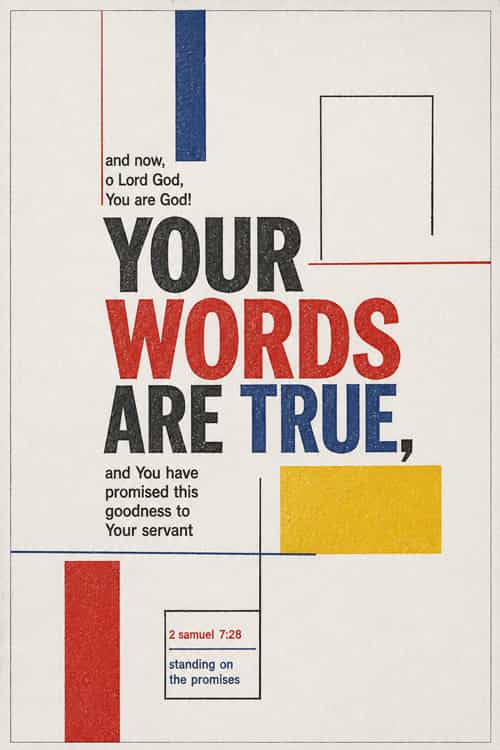
And now, O Lord God, You are God! Your words are true, and You have promised this goodness to Your servant. – 2 Samuel 7:28
There is a quiet confidence in David’s words that is easy to miss. He does not begin by explaining how God will fulfill His promise or by trying to understand everything that lies ahead. He simply looks at who God is and says, “Your words are true.”
God Does Not Need Us to See the Whole Picture
David had received a promise from God, but the promise itself was larger than anything he could accomplish or control. He could not see every detail of how it would unfold. What he could do was trust the One who had spoken.
We often want faith to give us a clear picture of what comes next. We would like to know how a difficult situation will resolve, when an answer will come, or what God is doing behind the circumstances we can see. But faith does not always give us that kind of clarity. Sometimes it gives us something quieter: confidence in God’s character when the path ahead remains hidden.
That is why David’s words matter. “Your words are true” does not depend on whether David can already see the outcome. God’s truth is not made more certain by our understanding of it.
What We Know About God Matters While We Wait
There are seasons when circumstances seem to raise questions that we cannot answer. A prayer may seem to linger. A promise may feel distant. Something we hoped would happen may take a direction we did not expect.
In those moments, it is natural to focus on what we cannot see. David’s response points us back to what he does know. “You are God.” Then, “Your words are true.” His confidence rests first in God’s identity and character, not in his ability to predict the future.
That gives us somewhere steady to stand. We may not understand what God is doing, but we can still remember who He is. We may not know when a promise will unfold, but we can still trust the One who made it.
The Shepherd Does Not Need to Explain Every Turn
A sheep following its shepherd does not need to understand the entire journey. It stays near the one who knows where the path leads. There is a kind of humility in that, and perhaps that is part of what trusting God asks of us.
We sometimes think trust will come once we have enough information. Yet David’s words suggest another way. Trust can begin with what has already been revealed. God has spoken. His words are true. We can rest there even while some questions remain unanswered.
A Simple Place to Rest
David’s response is remarkably simple, and perhaps that is part of its comfort. He does not claim to understand everything. He simply acknowledges the God who has spoken and the truthfulness of His words.
When you cannot see what God is doing, you do not have to pretend that you can. You can bring your questions to Him without surrendering your confidence in His character. There may be much you do not know, but you can still hold onto what you do know.
God is God. His words are true. And sometimes, when the road ahead is hidden, that is enough to take the next step with the Shepherd.