
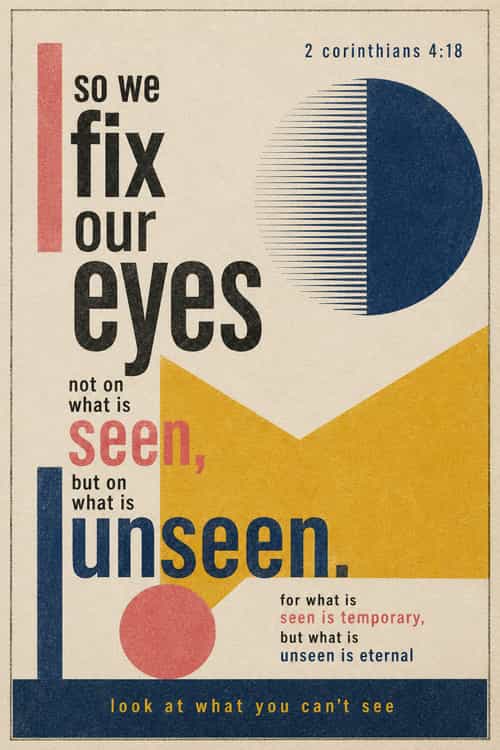
So we fix our eyes not on what is seen, but on what is unseen. For what is seen is temporary, but what is unseen is eternal. – 2 Corinthians 4:18
What are you looking at when life feels uncertain? Paul gives us a surprisingly direct answer. He does not tell us to stop seeing what is around us. He tells us not to fix our eyes on it. There is a difference.
What we see is real. Our circumstances are real. So are the disappointments, responsibilities, losses, and joys that fill our days. But Paul reminds us that what is visible is not the whole story. In fact, some of the things that matter most cannot be seen at all.
Why does Paul tell us to look at what is unseen?
It is easy to give our attention to whatever is directly in front of us. A difficult conversation occupies our thoughts. A financial concern follows us through the day. A change in our circumstances can make us wonder what God is doing. What we can see has a way of becoming what we think is most important.
Paul does not deny any of these realities. He simply puts them in their proper place.
What is seen is temporary. That word changes the way we look at the things around us. The trouble we are facing may feel permanent when we are in the middle of it, but it is not. Neither are our successes, possessions, physical strength, or earthly circumstances. They belong to this present life.
The unseen is different. God is unseen. So is His presence. His promises are unseen. Faith itself reaches beyond what our eyes can confirm. And the eternal life God has promised us cannot be measured by anything we can see today.
What does it mean to fix our eyes on the unseen?
Paul is not asking us to pretend that visible things do not matter. He is teaching us where our deepest attention should rest.
We can look directly at a difficult circumstance and still believe that God is greater than it. We can acknowledge what has been lost without believing that everything has been lost. We can face an uncertain future without assuming that God is absent simply because we cannot see what He is doing.
That takes faith. Faith does not require us to close our eyes to reality. It teaches us to see reality in light of something greater.
There is a quiet humility in that. We are creatures who see only a small part of what God sees. Like sheep following a shepherd, we do not need to understand every turn in the path before we take the next step. We need to trust the One who sees what we cannot.
How can this change the way we see our circumstances?
Perhaps the question is not whether we will look at what is happening around us. We will. The question is whether what we see will become the measure of what we believe.
A temporary circumstance can feel enormous when it occupies our entire field of vision. But Paul pulls our attention back. There is more than what is happening today. There is more than what we can measure, explain, or understand.
God is still at work when His work is hidden from us.
That does not make suffering easy, and Paul is not offering a quick way around it. He is pointing us toward a different way through it. Instead of allowing the visible world to define the limits of our hope, we learn to let God’s eternal promises shape how we understand the visible world.
Our eyes will naturally return to what is in front of us. That is why Paul says we fix them. It takes intention. Again and again, we turn our attention away from what seems ultimate and back toward the God who is.
We may not be able to see what He is doing. But we can trust Him while we wait to see.
What are we really looking for?
There is something deeper here than simply learning to think positively about difficult circumstances. Paul is teaching us where to place our hope.
Everything visible is passing. Even the most beautiful things we experience in this life are temporary. But the God who created what we can see is not temporary, and neither are His promises.
So when your eyes are drawn toward everything that is changing, remember what does not change. When circumstances seem to have the final word, remember that they do not. And when you cannot see where God is leading, you can still fix your eyes on Him.
What is unseen is not less real because we cannot see it. For the Christian, it is where the deepest reality lies.
Perhaps today we simply need to look again.