
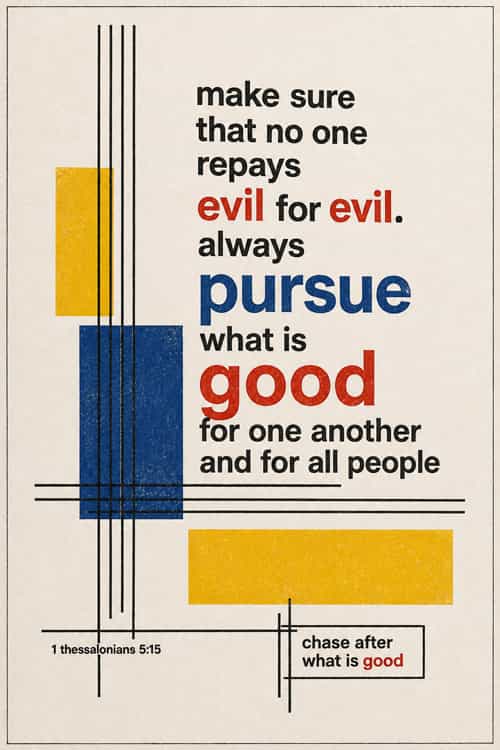
Make sure that no one repays evil for evil. Always pursue what is good for one another and for all people. – 1 Thessalonians 5:15
What do we do when someone treats us badly? It can feel natural to keep the offense in front of us, turning it over in our minds and imagining what we could do to make things even. But 1 Thessalonians 5:15 points us in a very different direction: do not return evil for evil. Instead, pursue what is good.
Why is it so difficult to let go of retaliation?
Part of the struggle is that we want things to be made right. When someone hurts us, we want them to understand what they have done. We may even believe that giving them a taste of their own behavior would somehow restore the balance.
But Paul does not tell us to wait until the other person deserves kindness. He gives us a different standard altogether. Their actions do not determine ours.
That is an important distinction. If someone responds harshly, we do not have to become harsh. If someone is unfair, we do not have to become unfair. We are not called to mirror the behavior we have received.
Pursue what is good!
The word pursue gives this instruction some weight. Paul is not describing goodness as something passive that happens if the right opportunity happens to come along. There is intention here. We are to go after what is good.
That might mean choosing a gracious answer when a sharp one would be easier. It might mean refusing to speak badly about someone who has hurt us. Sometimes it may simply mean praying for the person instead of continuing to rehearse the offense.
And notice the scope of the command. We are to pursue what is good not only for the people we naturally like, but for one another and for all people. The gospel reshapes the boundaries of our concern.
How does humility change the way we respond to wrong?
Humility helps us remember that we are not standing above the people who have failed us. We are sheep who need the Shepherd’s grace just as much as anyone else. That does not make wrongdoing acceptable, and it does not mean that every harmful situation should simply be ignored. But it does remind us that revenge is not ours to carry.
Jesus gives us a better way. He did not wait for us to become worthy before extending His grace. His love moved toward sinners who could not make themselves right with God. When we remember the mercy we have received, it becomes harder to justify withholding mercy from someone else.
There may still be times when boundaries are necessary, truth needs to be spoken, or wrong needs to be addressed. Pursuing what is good does not require pretending that evil is good. It means refusing to let someone else’s sin determine the character of our response.
What can I pursue today?
Perhaps the simplest place to begin is with the person who immediately comes to mind when you read this passage. Instead of asking what they deserve, ask what would be good. Instead of planning how to answer the offense, consider what would reflect Christ.
We cannot control how other people treat us. We can, by God’s grace, choose what we will pursue. And Paul gives us a remarkably clear direction: not payback, not resentment, not evil for evil, but what is good.
That is the path of someone learning to follow the Shepherd.