
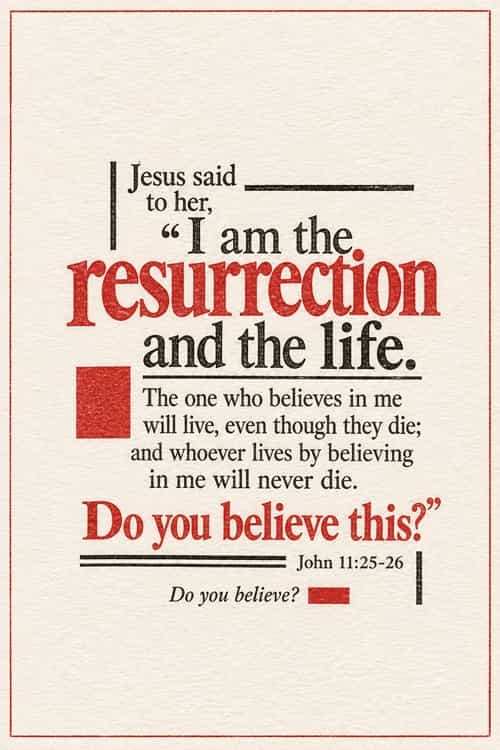
Jesus said to her, “I am the resurrection and the life. The one who believes in me will live, even though they die; and whoever lives by believing in me will never die. Do you believe this?” – John 11:25-26
Jesus asks Martha a question that reaches far beyond the immediate sorrow of losing her brother: “Do you believe this?” He asks it while Lazarus is still in the tomb, before Martha has seen what Jesus is about to do. The timing of that question reveals something important about the nature of faith.
Faith When the Answer Has Not Yet Come
Martha’s circumstances were difficult. Her brother had died, and Jesus had arrived after the burial. She knew He had the power to heal Lazarus. In fact, she told Him that if He had been there, her brother would not have died. She also believed that God would grant whatever Jesus asked of Him. Her faith was real, but her understanding of what Jesus was about to reveal had not yet reached its full depth.
When Jesus spoke about the resurrection, Martha understood His words in terms of a future event. She knew Lazarus would rise again at the resurrection on the last day. Jesus then brought the truth much closer to her present circumstances. He declared that He Himself was the resurrection and the life.
That distinction matters. Jesus was directing Martha’s attention away from the question of when resurrection would happen and toward the person in whom resurrection is found. Eternal life is inseparable from Him. His authority over death does not depend on circumstances, timing, or what human understanding can presently grasp.
Then came the question: “Do you believe this?”
Believing in the Person, Not Just the Promise
Faith can sometimes become closely associated with believing that God will bring about a particular outcome. We pray for healing, ask for help, and hope for circumstances to change. These are natural expressions of trust in God. But our faith can become unsettled when events unfold differently from what we had hoped.
Jesus’ words to Martha point toward something more enduring. He does not ask her to believe that Lazarus will be restored before He speaks. He asks her to believe in Him. The foundation of her faith is the person of Christ, whose identity and authority remain unchanged regardless of what she can see at that moment.
This is an important distinction in our own relationship with God. Believing in Jesus does not mean we understand everything He allows or know how every difficult situation will unfold. It means placing our trust in the One who has revealed Himself as the source of life. Our confidence rests in His character and His victory over death, even when the immediate circumstances leave us with unanswered questions.
There is also something deeply personal about the way Jesus approaches Martha. He does not dismiss her grief or demand that she set aside her sorrow before speaking about faith. He meets her in the middle of it and invites her to consider who He truly is. Her understanding can grow through that encounter, just as ours continues to grow as we walk with Him.
A Question Worth Returning To
The question Jesus asked Martha remains relevant because faith is never merely an idea we agree with. It involves a relationship with the living Christ. We may know the promises of Scripture and understand the basic truths of the gospel, but there are moments when those truths become especially personal. Difficult circumstances can bring us face to face with what we actually believe about the One we follow.
As sheep depend upon their shepherd for direction and care, we learn to depend upon Christ, trusting Him even when the path ahead is unclear. This dependence requires humility because it acknowledges that our understanding has limits. We do not have to see the whole picture to place our confidence in the One who does.
Jesus did not ask Martha to explain the mystery of resurrection. He asked her whether she believed in Him. That remains the heart of Christian faith. The promise of eternal life is bound to the person of Jesus Christ, the One who entered death and overcame it. His question invites each of us to consider where our confidence truly rests.