
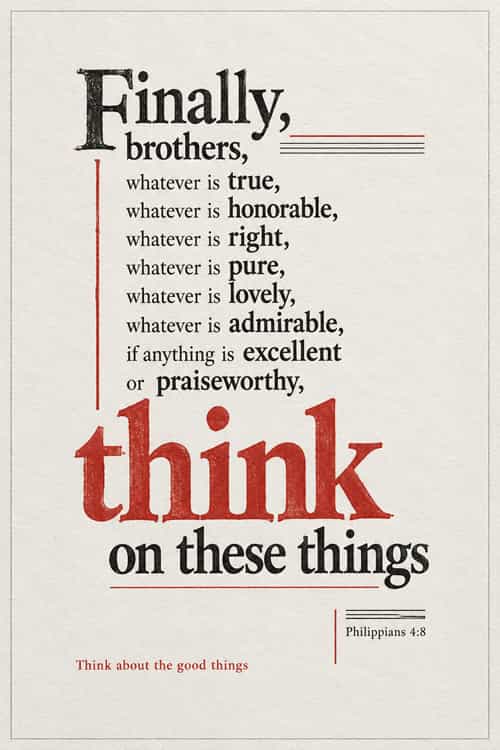
Finally, brothers, whatever is true, whatever is honorable, whatever is right, whatever is pure, whatever is lovely, whatever is admirable, if anything is excellent or praiseworthy, think on these things. – Philippians 4:8
Paul does not tell us merely to stop thinking about the wrong things. He gives our minds somewhere better to go: toward what is true, honorable, right, pure, lovely, admirable, excellent, and worthy of praise. The Christian life includes learning what deserves our attention.
What deserves a place in our minds?
Paul’s list is striking because it reaches into the ordinary places where our thoughts spend their time. Truth matters. So does what is honorable. Purity matters, but so does loveliness. Paul is not describing a narrow religious mindset that ignores the goodness around us. He is teaching us to recognize what is worthy of our attention.
That requires a certain kind of attentiveness. Our minds can settle easily on what is troubling, disappointing, offensive, or uncertain. Those things may be real, but they do not deserve every moment of our attention. Philippians 4:8 turns our eyes toward what is good and trustworthy, toward things that reflect the character of God.
Not everything deserves our attention
We cannot always choose what enters our minds. A difficult conversation, an anxious thought, or unsettling news may arrive without invitation. But we can become more deliberate about what we continue to dwell on.
Paul’s words give us a way to examine those thoughts. Is this true? Is it honorable? Is it pure? Is there anything lovely here that I am overlooking? Is there something excellent or praiseworthy that deserves more of my attention?
Those questions can gently interrupt the habit of letting fear or negativity occupy the whole room of our minds. They turn our attention back toward reality as God has made it and toward the goodness that is still present within it.
A mind turned toward what is good
This kind of thinking is not pretending that difficult things do not exist. Paul knew very well that suffering, uncertainty, and hardship are part of life. Christian hope does not require us to close our eyes to them. It teaches us not to let them become the only things we see.
There is a quiet discipline in noticing what is true when anxiety wants to speculate, what is lovely when disappointment has made everything seem dull, and what is praiseworthy when criticism has become easier than gratitude. Like a sheep learning to stay near its shepherd, we learn where our attention is safest by repeatedly turning toward what is good and true.
Think on these things
Paul ends with a simple instruction: think on these things. Not occasionally. Not only when life feels peaceful. He calls us to give these things our attention.
Perhaps that is where the verse becomes especially practical. The next time your thoughts begin circling around what is wrong, pause and look again. There is truth to hold onto. There is goodness to notice. There is something worthy of praise. We may not be able to control every thought that comes to us, but we can learn, by God’s grace, what we will allow to remain.
What fills the mind gradually shapes the heart. Philippians 4:8 invites us to fill it with things that draw our attention back toward the goodness of God.